Tracking your child’s growth at home: height and weight, the calm way
How to measure your child’s height and weight at home, read a growth chart without worry, and keep the numbers from becoming something kids fret about.

Every family has a doorframe with pencil marks on it. A line, a date, a child standing very straight and trying not to go on tiptoe. Those marks are a growth chart in its simplest form, and they work because they show the one thing that matters most: how a child grows over time.
This guide covers how to measure height and weight properly at home, how often is enough, how to read a growth chart the way a paediatrician does, and how to keep the whole thing light so your child never learns to worry about a number. It is not a way to judge whether a child is growing well. That is your paediatrician’s call.
The short version
- Measure height every few months and weight about once a month, the same way each time. More often adds worry, not information.
- On a growth chart, the shape of the line over years matters far more than any single point. A child who drifts across the lines, up or down, is worth a conversation with the paediatrician.
- Keep it routine and neutral: no praise or criticism for a number, no comparing siblings. Dial H40 plots height and weight growth charts in the InBody app for children 6 and up.
Why track growth at home at all
Paediatricians measure children at check-ups, but those visits can be months or years apart once vaccinations are done. A simple record at home fills the gaps. When you do see the doctor, you can show a line instead of trying to remember whether your daughter really shot up last summer.
Growth is also a quiet signal of general health. Height and weight that keep pace with a child’s own curve usually mean food, sleep and activity are roughly right. A curve that flattens or swerves does not tell you what is wrong, or whether anything is, but it is the kind of thing a doctor wants to hear about early.
The goal is a record, not a scoreboard. Done well, measuring is as unremarkable as brushing teeth.
Measuring height properly
Height is easy to get slightly wrong, and a centimetre or two can be several months of a child’s growth. A few habits keep it honest.
- Pick one spot. A flat wall with no skirting board, on a hard floor, not a rug.
- Shoes and hair clips off. Bare feet, heels together, plaits and buns undone if they push the head forward.
- Stand tall, not on tiptoe. Back of the head, shoulders, hips and heels against the wall, eyes looking straight ahead.
- Use something flat and square. A hardback book held level against the wall, pressed gently onto the crown. Mark under it with a pencil.
- Measure twice. Read a steel tape from floor to mark, and write down the date. If two readings differ, take a third.
Very young children who cannot stand still are measured lying down by doctors, as length rather than height. At home, simply leave that to your paediatrician.
Weighing children at home
Weight is easier to measure, and easier to overdo. For most families, once a month is plenty. Children’s weight moves with meals, water and the toilet just as adults’ does, and daily numbers mostly measure lunch.
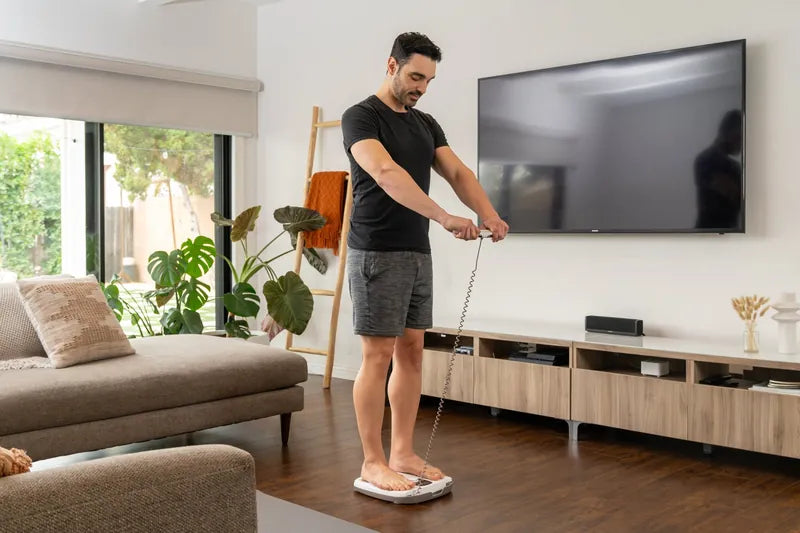
Use the same scale, at the same time of day, in light clothes or none. Morning, after the toilet and before breakfast, is the most consistent. Small children may need you to stand close or help them balance.

A body composition scale also needs height for its calculations, so keep each child’s height up to date in their profile whenever you measure. And a few cautions apply to every Dial: InBody advises that anyone with an implanted electronic medical device such as a pacemaker should not use one, and the scale belongs on a hard, dry floor, not in the bathroom.
Reading a growth chart without panic
A growth chart plots height or weight against age. The curved lines on it are percentiles. If a child sits on the 50th percentile line, about half of children of the same age and sex are taller and half are shorter. On the 75th, about three in four are shorter.
That is all a percentile means. It is not a grade. A child on the 25th percentile who stays there year after year is usually growing exactly as they should; plenty of healthy children are small or tall because their parents are.
Which chart applies in India
Doctors in India mostly use two references. For children under five, the Indian Academy of Pediatrics (IAP) recommends the WHO Child Growth Standards. From 5 to 18 years, it recommends its own revised IAP growth charts for height, weight and body mass index, built from measurements of Indian children. Ask your paediatrician which chart they use for your child, and plot against that one so your numbers and theirs speak the same language.
What doctors actually look at
- The direction of the line, measured over months and years, not weeks.
- Crossing lines. A child who moves steadily from one percentile band to another, up or down, gets a closer look.
- Height and weight together. Weight rising much faster than height, or height stalling while weight carries on, are both worth mentioning.
- The whole child. Appetite, energy, sleep, illness and development all count as much as the chart.
If anything on your chart looks off, write the dates and numbers down and take them to your paediatrician. Do not change a child’s food on your own because of a percentile.
Keeping it calm for children
Children notice everything about how adults talk about bodies. A scale that becomes a source of comments, good or bad, can stay with them for years. A few habits keep measuring neutral.
- Treat it like the doorframe. “Let’s see how much you’ve grown” works. “You’ve put on weight” does not.
- Never praise or scold a number. Praise sleep, play, trying a new vegetable, carrying the shopping bag up the stairs.
- No comparisons. Not with siblings, cousins or classmates. Each child has their own curve.
- Keep the records for the grown-ups. Children can watch their height go up with pride. The weight log is for you and the doctor.
- Watch your own language. If children hear adults call themselves fat or talk about “bad” food, they learn it fast.
- No diets without a doctor. Growing bodies need enough food. Any change to a child’s eating should come from a paediatrician or dietitian.

Using a Dial to keep the record
A pencil and a doorframe will do. If you would rather the record kept itself, a scale that recognises each family member and syncs to an app makes it effortless, and the trend is there when the doctor asks.
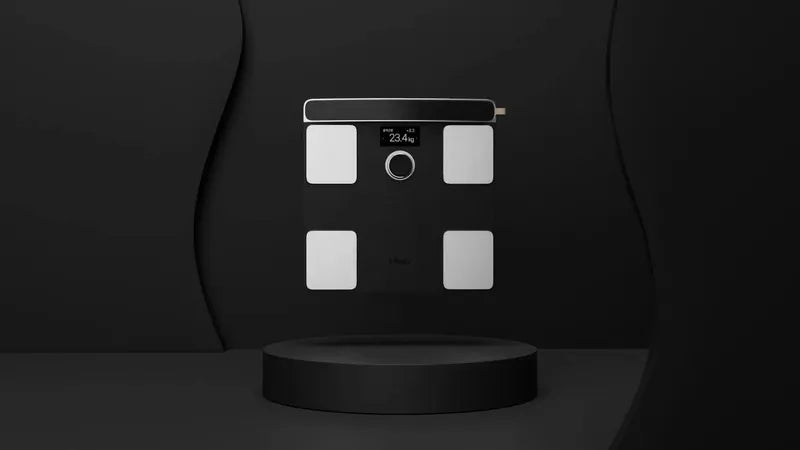
Dial H40 is the model with growth charts. Among its 14 readings are a growth chart for height and a growth chart for weight, plotted in the InBody app, and it can be used from age 6. Dial H30 can be used from age 3 with an adult’s help, but it does not have the growth charts. Both recognise up to 20 people and sync over home Wi-Fi, so each child just steps on and their results go to their own profile. Setting up profiles is covered in the InBody app setup guide.


Whatever the chart shows, it is a record to bring to your paediatrician, not something to act on alone. Dial is a fitness and wellness tracking device, and for children, height and weight over time are the main story. If you are curious about anything beyond that, ask your doctor how to read it. For grown-ups in the same house, how often to weigh yourself has the adult version of this advice.
 Dial H40Height and weight growth charts for children 6 and up, and 14 readings for the adults.See Dial H40 →
Questions people ask
How often should I measure my child’s height and weight?
For most families, height every three to six months and weight about once a month is plenty. Children grow in spurts, so short-term changes say little. Follow your paediatrician’s advice if they ask for something different.
Which growth chart is used in India?
The Indian Academy of Pediatrics recommends the WHO Child Growth Standards for children under five, and the revised IAP growth charts for height, weight and body mass index from 5 to 18 years. Your paediatrician can tell you which one they use.
My child is on the 10th percentile. Is that a problem?
Not on its own. A percentile only shows where a child sits compared with others of the same age and sex. What doctors look at is whether the child keeps to their own curve over time. If you are worried, take your measurements to your paediatrician.
From what age can a child use InBody Dial?
Dial H40 can be used from age 6, and Dial H30 from age 3 with an adult’s help. Children on Dial H20 also need an adult to help. InBody advises that anyone with an implanted electronic medical device such as a pacemaker should not use a Dial.
Should my child see their weight?
Many families keep the weight record for the adults and let children follow their height, which they usually find exciting. Whatever you choose, keep the tone neutral and never praise or criticise a number.
Sources
- Indian Academy of Pediatrics Growth Charts Committee; Khadilkar V, Yadav S, Agrawal KK, et al. Revised IAP growth charts for height, weight and body mass index for 5- to 18-year-old Indian children. Indian Pediatrics 2015;52(1):47–55.
- WHO Multicentre Growth Reference Study Group. WHO Child Growth Standards: length/height-for-age, weight-for-age, weight-for-length, weight-for-height and body mass index-for-age: methods and development. Geneva: World Health Organization, 2006.
- de Onis M, Onyango AW, Borghi E, et al. Development of a WHO growth reference for school-aged children and adolescents. Bulletin of the World Health Organization 2007;85(9):660–667.
- InBody Dial H20, H30 and H40 specifications, InBody India.
 Dial H40
 Dial H30
 Dial H20