Smart scale vs InBody Dial: what a foot-only scale can’t see
Most smart scales send a current up one leg and down the other, then guess the rest of you. Here is what that misses, and what changes with hands and feet.
Step on most smart scales and you get a body fat number in two seconds. It looks precise. It comes with a decimal point. But the current behind it never left your legs, and everything above your hips was worked out from a formula.
That is not a flaw in any one brand. It is how foot-to-foot scales are built. This guide explains what they measure, what they estimate, and what changes when a scale holds you at the hands and the feet.
The short version
- A foot-only scale measures the path between your feet: legs and lower body. The rest is estimated.
- InBody Dial uses 8 electrodes at your hands and feet and measures each arm, each leg and the trunk separately.
- Both can be useful. If you only want weight, any good scale will do. If you want to know whether you are losing fat or muscle, the measurement path matters.
How a regular smart scale measures you
Every body composition scale uses bioelectrical impedance analysis, or BIA. A tiny current that you cannot feel passes through your body. Lean tissue holds a lot of water and conducts it easily. Fat holds little water and resists it. From that resistance, the scale works out how much of you is lean and how much is fat.
On a typical smart scale, the only contact points are under your feet. So the current takes the shortest route it can: up one leg, across the pelvis, down the other leg.
Your arms, your chest, your back and your belly are not on that path. The scale fills them in with an estimate built from your height, age, sex and weight, using equations made from population averages.
What that estimate misses
Population equations work well for the average person. Most of us are not average in at least one way that matters.
- Upper body versus lower body. Someone who walks a lot but never lifts can have strong legs and very little upper-body muscle. A leg-only reading can flatter them.
- The belly. Many Indians carry fat around the middle at a normal weight, a pattern researchers call the Asian Indian phenotype (more in skinny fat). The trunk is exactly the part a foot-only scale cannot see.
- Change over time. If you start strength training, your arms and back often change first. An estimate based on your legs may barely move.
- Assumptions about you. When a scale leans on age and sex to fill gaps, two very different 35-year-old men of the same height and weight can get surprisingly similar results.

What InBody Dial does differently
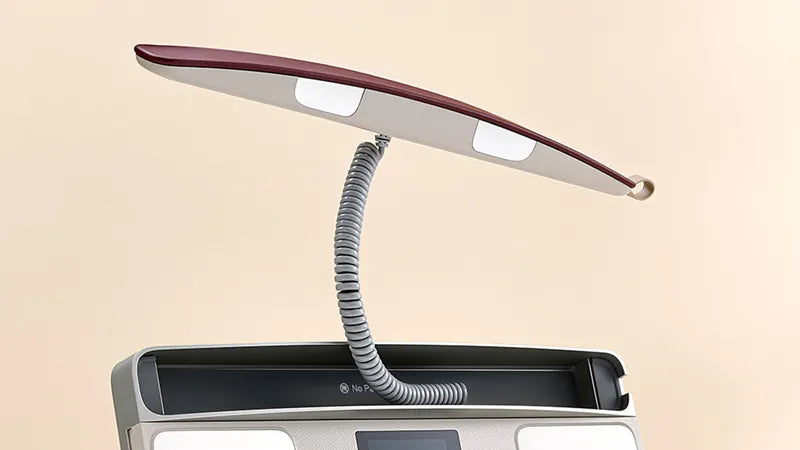
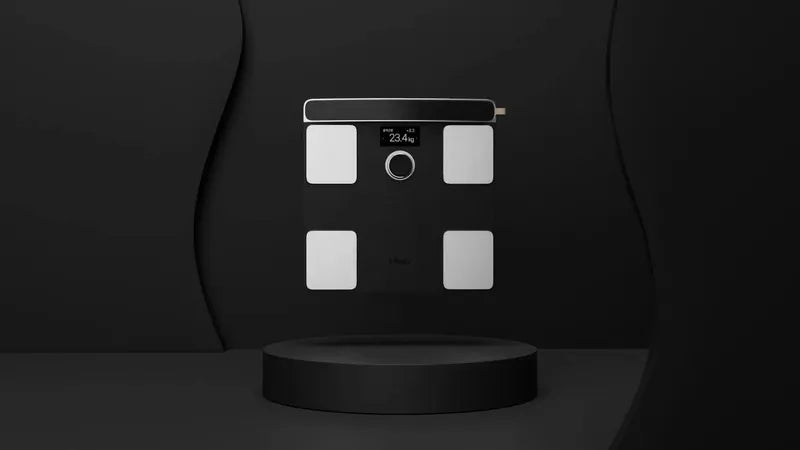
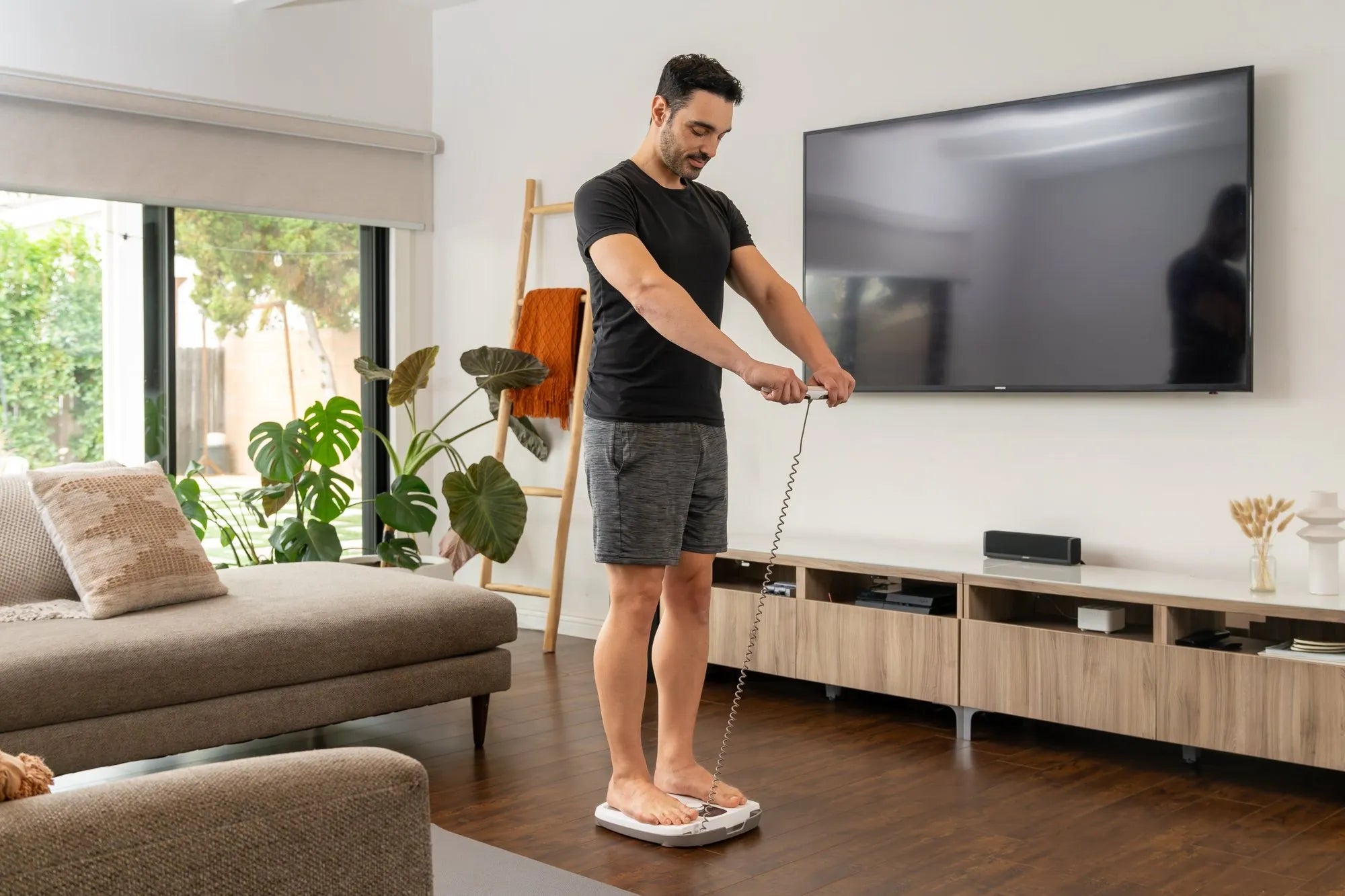
A Dial holds you at four places, not two. Your feet stand on steel electrodes, and your hands hold a handle with electrodes under your palms and thumbs. That is 8 contact points in total.
With current able to enter and leave at the hands as well as the feet, the Dial measures each arm, each leg and the trunk as separate segments. InBody calls this direct segmental measurement. Instead of reading your legs and guessing the rest, it reads the rest.
Dial H30 and H40 also measure at three frequencies: 5, 50 and 200 kHz. Low frequencies travel around your cells, through the water outside them. Higher frequencies pass through the cell walls. Comparing the two gives a fuller picture of the water in your body, which is where muscle lives.


| Typical smart scale | InBody Dial | |
|---|---|---|
| Contact points | 2 to 4, feet only | 8, hands and feet |
| Measured directly | Legs and lower body | Each arm, each leg, trunk |
| Upper body | Estimated from a formula | Measured |
| Frequencies | Usually one | Three on H30 and H40 (5, 50, 200 kHz); two on H20 |
| Muscle reading | Often "muscle mass", a wider lean estimate | Skeletal muscle mass, the muscle you train |
| Test time | A few seconds | About 10 seconds on H20, about 20 on H30 and H40 |
Does that make the number “right”?
No home device is a lab. DXA scans and four-compartment models are the reference methods researchers use, and they cost far more than any scale. The honest question is how close a home device gets, and whether it tracks change well.
For Dial H20, there is published data. In a 2023 study in the British Journal of Nutrition, researchers compared 15 consumer BIA devices against a four-compartment model in 73 adults. The InBody H20N, the model sold in India as Dial H20, was rated “very good” and tracked change over 12 to 16 weeks. A 2026 study in adults with obesity found excellent agreement with DXA for body fat percentage.
The useful number is not today’s reading. It is the line your readings make over eight weeks.
That is the part people underrate. A body composition scale earns its place by being consistent: same method, same posture, same conditions, every time. Then a half-kilo drop in fat or a small gain in muscle shows up as a real trend rather than noise.
Which one do you actually need?
Be honest about the question you want answered.
A regular scale is enough if…
- You only want to track weight.
- You are happy with a rough fat estimate.
- Nobody at home is training, recovering or on a weight-loss plan.
A Dial is worth it if…
- You want to know whether you are losing fat or muscle.
- You carry weight around the middle and want to watch visceral fat.
- You lift, run, or are rebuilding strength after a break.
If you are choosing between models, start with who will use it. Dial H20 is for one person over Bluetooth. Dial H30 recognises up to 20 people and syncs over home Wi-Fi. Dial H40 adds leg muscle level and three balance ratings for people who train.
 Dial H30For the whole house. Knows who stepped on, syncs over Wi-Fi, 12 readings.See Dial H30 →
How to get readings you can trust
- Same time, same state. Morning is easiest: after the toilet, before breakfast and before exercise.
- Bare feet, dry skin. Socks block the current. Very dry feet can too, so a quick wipe with a damp cloth helps.
- Hold the handle properly. Palms and thumbs on the electrodes, arms straight and slightly away from your sides.
- Stay still for the whole test. Do not talk or shift your weight until the result appears.
- Skip it after a workout, sauna or a big meal. Water moves around your body for a while afterwards.
Questions people ask
Why does my smart scale show a different body fat percentage from the Dial?
They measure different paths. A foot-only scale reads your legs and estimates the rest, while a Dial measures arms, legs and trunk. Different methods, different equations, so the numbers rarely match. Pick one device and track the trend on it.
Is a body composition scale safe?
The current is tiny and you will not feel it. InBody advises that people with an implanted electronic medical device such as a pacemaker should not use it, and that pregnant women check with their doctor first.
Can a Dial tell me if I am healthy?
It is a fitness and wellness tracking device, not a medical device. It shows what your weight is made of and how that changes. For anything about your health, talk to your doctor and bring your trends along.
Do I need my phone next to the scale?
Not with Dial H30 or H40. They sync over home Wi-Fi and keep up to 15 results per person if the connection drops. Dial H20 syncs over Bluetooth, so keep your phone nearby.
Can I keep it in the bathroom?
No. Dial H30 and H40 are rated IP21, which covers drips, not steam or splashes. Keep it in a dry room on a hard, level floor.
Sources
- Siedler MR et al. Assessing the reliability and cross-sectional and longitudinal validity of fifteen bioelectrical impedance analysis devices. British Journal of Nutrition 2023;130:827–840.
- Ellison et al. Assessing body composition for resource-limited settings: agreement of a scalable BIA device compared to DXA and clinical BIA in adults with obesity. Journal of Primary Care & Community Health 2026;17.
- Misra A, Khurana L. The metabolic syndrome in South Asians: epidemiology, determinants, and prevention. Metabolic Syndrome and Related Disorders 2009;7(6):497–514.
- InBody Dial H20, H30 and H40 specifications, InBody India.
 Dial H40
 Dial H30
 Dial H20