Weight not reducing? Why the scale stalls while your body changes
The scale has not moved in weeks, yet your clothes fit differently. How recomposition and water hide progress, and the numbers that show what is changing.

If your weight is not reducing but your waist is, you are probably not stuck. Two things commonly hide progress on an ordinary weighing machine. You may be losing fat while gaining or holding muscle. And water can move your weight up or down by a kilo or so between one morning and the next.
A true plateau does happen too, usually after weeks of steady loss, as a smaller body needs less energy. This guide helps you tell the three apart, and shows which readings to look at when the total refuses to budge.
The short version
- Your weight is fat, muscle, water and everything else added together. If fat goes down while muscle goes up, the total can sit still.
- Salt, festival meals, long journeys, hot weather and the menstrual cycle move water, and water moves your weight within days.
- Body fat mass and skeletal muscle mass, tracked monthly, tell you what the weight cannot.
Why the scale stops moving
You are recomposing
When you start strength training, or come back to it after a break, it is common to lose fat and gain muscle at the same time. The two can roughly cancel out on the scale. Your trousers loosen, your arms look firmer, and the number stays where it was. This is not a plateau. It is the result you wanted, hidden inside a total.
Water is moving
Your body stores carbohydrate as glycogen, and glycogen is stored with water. Researchers writing in the American Journal of Clinical Nutrition described how filling and emptying these stores can make weight swing quickly in either direction, with little to do with fat. Add salt, heat and hormones, and a normal week can look chaotic.
You have hit a real plateau
As you lose weight, your body gets smaller and needs less energy to run. Modelling work by Kevin Hall and colleagues showed that the same eating plan produces slower and slower loss over time, until weight levels off. Habits also drift: portions creep back, daily steps fall. This one needs a change of plan.
Water swings: the Indian calendar edition
Indian life has a rhythm that a weighing machine takes personally. None of these is fat gain, and all of them can show up on the scale the next morning.
- Festivals and weddings. Sweets, fried snacks and late dinners mean more carbohydrate, more salt and more food still in your gut. The extra kilo after Diwali is mostly water and food, not fat.
- Salt. Pickles, namkeen, chips and restaurant food hold water in your body for a day or two. WHO advises adults to keep salt under 5 grams a day.
- Monsoon travel. Long train or bus journeys, hours of sitting, salty food on the way and less water than usual can all show up as a heavier morning.
- Heat. Sweating it out on a hot day can make you lighter, and rehydrating brings it back.
- Periods. Many women notice they retain water in the days before a period, and the scale climbs then falls again.
What the fat and muscle trends tell you
A body composition scale splits the total into the parts you care about. Read them together and the stalled number usually makes sense.
| What you see | What it often means | What to do |
|---|---|---|
| Weight flat, fat down, muscle up | Recomposition | Keep going |
| Weight up overnight, fat unchanged | Water and food | Ignore it; check the weekly average |
| Weight down, muscle down sharply | Losing muscle with fat | More protein, keep lifting |
| Weight and fat both flat for a month | A real plateau | Adjust food or activity |


This only works if the measurements are consistent. For Dial H20, a 2023 study in the British Journal of Nutrition found it tracked changes in body composition over 12 to 16 weeks. Our guide to how accurate body fat scales are explains why your routine matters as much as the device.
How to break a real plateau
If four weeks of readings show weight and fat both flat, something needs to change. Start with the simplest levers.
- Recheck portions. A smaller body needs less food than it did at the start. What worked three months ago may now be maintenance.
- Put protein in every meal. Dal, curd, paneer, soy, eggs. Protein helps you hold on to muscle while you lose fat.
- Lift twice a week or more. WHO recommends muscle-strengthening activity on two or more days a week. It is the best protection for your muscle line.
- Walk more between meals. Daily movement outside workouts tends to drop quietly as weight falls. Count it again.
- Sleep, then reassess. Give any change three to four weeks before judging it.
If you are losing weight on prescribed medication, talk to your doctor before changing your plan, and read our guide to weight-loss medication and muscle.
 Dial H30For the whole house. Body fat mass and skeletal muscle mass at every test, for up to 20 people, synced over Wi-Fi.See Dial H30 →
How to weigh in without losing your mind
Test at the same time each day, ideally in the morning after the toilet and before food or exercise. Avoid testing right after a shower, a workout or a big meal. Then stop reacting to single mornings. Look at the weekly average for weight, and the monthly trend for fat and muscle.

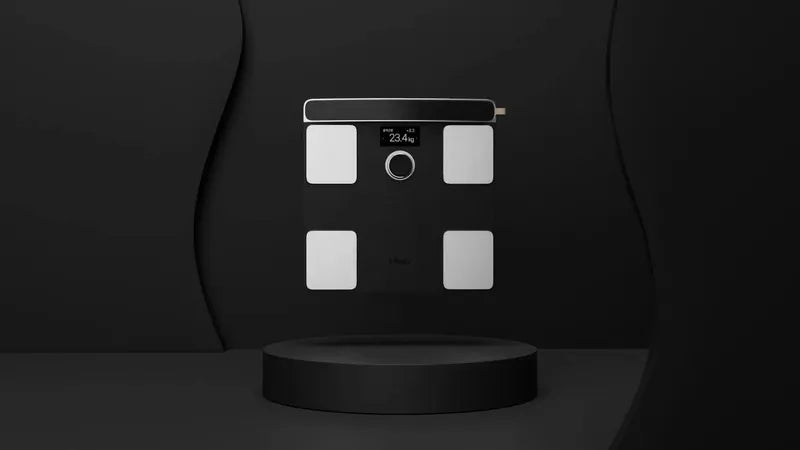
A single person can do this with Dial H20 over Bluetooth. For a family, Dial H30 recognises up to 20 people. If you lift seriously, Dial H40 adds leg muscle level and balance ratings.
Questions people ask
Why am I losing inches but not weight?
Most often you are losing fat and gaining or holding muscle at the same time. Muscle is denser than fat, so the same weight takes up less space. A body composition scale shows both changes separately.
How long does a weight loss plateau last?
There is no fixed length. If your weight and body fat have both been flat for about four weeks under consistent testing, treat it as a real plateau and adjust your food or activity.
Why did I gain 2 kg overnight?
Almost certainly water and food, not fat. A salty or carbohydrate-heavy meal, a late dinner or travel can push the next morning’s weight up. It usually settles within a few days.
Should I weigh myself every day?
You can, if single readings do not upset you. Daily weigh-ins give a better weekly average. Judge progress on that average and on monthly fat and muscle trends.
Does muscle weigh more than fat?
A kilo is a kilo. But muscle is denser than fat, so a kilo of muscle takes up less room. That is why your shape can change while your weight does not.
Sources
- Hall KD et al. Quantification of the effect of energy imbalance on bodyweight. The Lancet 2011;378(9793):826–837.
- Kreitzman SN, Coxon AY, Szaz KF. Glycogen storage: illusions of easy weight loss, excessive weight regain, and distortions in estimates of body composition. American Journal of Clinical Nutrition 1992;56(1 Suppl):292S–293S.
- World Health Organization. Guideline: sodium intake for adults and children. Geneva: WHO; 2012.
- Siedler MR et al. Assessing the reliability and cross-sectional and longitudinal validity of fifteen bioelectrical impedance analysis devices. British Journal of Nutrition 2023;130:827–840.
- World Health Organization. WHO guidelines on physical activity and sedentary behaviour. Geneva: WHO; 2020.
- InBody Dial H20, H30 and H40 specifications, InBody India.
 Dial H40
 Dial H30
 Dial H20