What is a BIA scale? How bioelectrical impedance works at home
A BIA scale sends a tiny current through your body and reads how water-rich tissue carries it. How that becomes fat and muscle, and what the method can’t do.
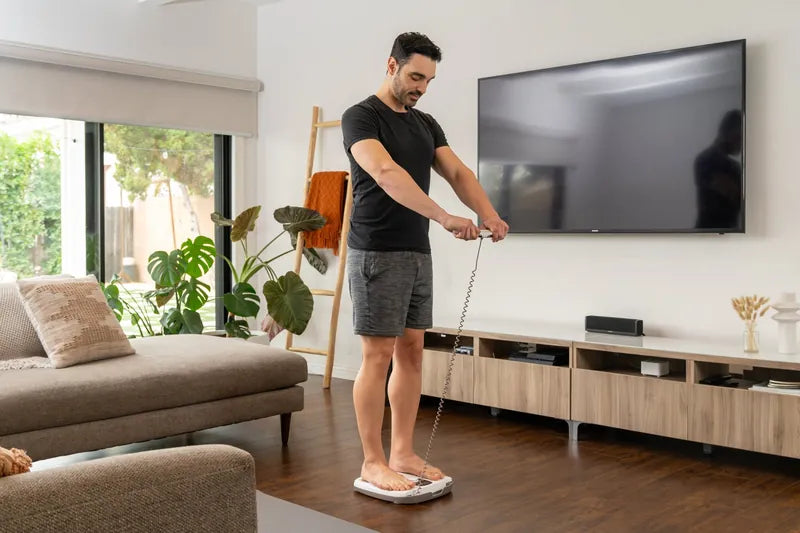
A BIA scale is a weighing scale that also passes a tiny, safe electrical current through your body. Lean tissue, which is mostly water, carries that current easily. Fat resists it. From how much the current is held back, the scale estimates how much of your weight is fat, muscle and water.
You may also see it sold as a BCA scale, short for body composition analyser, or simply as a bioelectrical impedance scale. It is the same idea. The differences between one BIA scale and another lie in the details: where the current goes in and out, how many frequencies it uses, and what the scale assumes about you. Those details decide how much of the result is measured and how much is filled in.
The short version
- BIA stands for bioelectrical impedance analysis. The scale measures how your body opposes a tiny current, then uses equations to turn that into water, lean mass and fat.
- Foot-to-foot scales read the path through your legs. Scales with a handle and 8 electrodes read each arm, each leg and the trunk separately.
- Using more than one frequency separates water inside your cells from water outside them. Food, drink, exercise and posture still move the result, so a steady routine matters.
How bioelectrical impedance works
Your body conducts electricity because it is full of water carrying dissolved salts. Muscle and other lean tissue are mostly water. Fat tissue holds much less. So when a small current passes through you, it travels easily through lean tissue and struggles through fat.
Impedance is the word for how strongly the body opposes that current. It has two parts. Resistance comes from the fluid the current must travel through. Reactance comes from cell membranes, which briefly hold charge like tiny capacitors. A BIA scale measures both, in ohms, many times during one short test.
Then comes the arithmetic. A long, thin wire resists more than a short, thick one, so the scale combines your impedance with your height, which stands in for the length of the conductor, and your weight. Equations built from studies of real people against laboratory methods turn those numbers into an estimate of body water.
- Current. A tiny current, far below anything you can feel, passes between the electrodes you are touching.
- Impedance. The scale measures how much your body resists and delays that current.
- Water. Impedance, height and weight go into equations that estimate total body water.
- Lean and fat. Lean tissue holds water in a fairly steady proportion, so lean mass follows from water. Fat is what is left: your weight minus your lean mass.

Notice that fat is never measured directly. It is calculated as the remainder. That is why anything that changes your body water for a few hours, such as a big meal or a hard workout, can nudge the fat number too.
Foot-to-foot or 8-point: where the current goes
A current can only travel between electrodes you are touching. On a typical smart scale, the plates sit under your feet, so the current goes up one leg, across the pelvis and down the other. Your arms and trunk are outside the circuit, and the scale fills them in from formulas. Our comparison of smart scales and InBody Dial walks through what that misses.
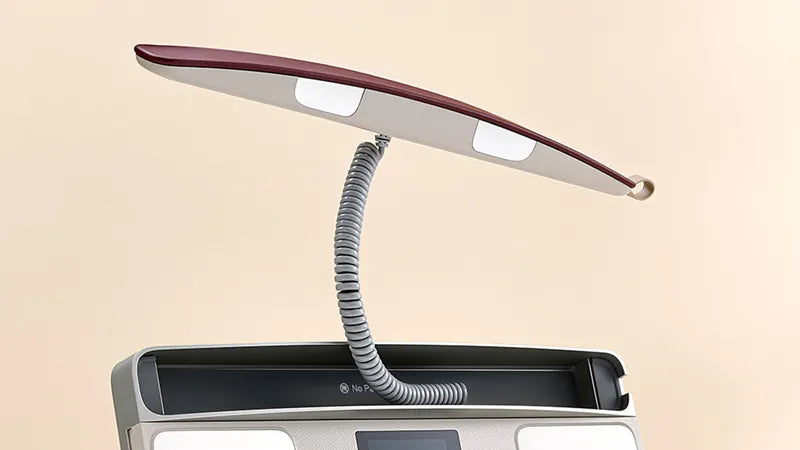
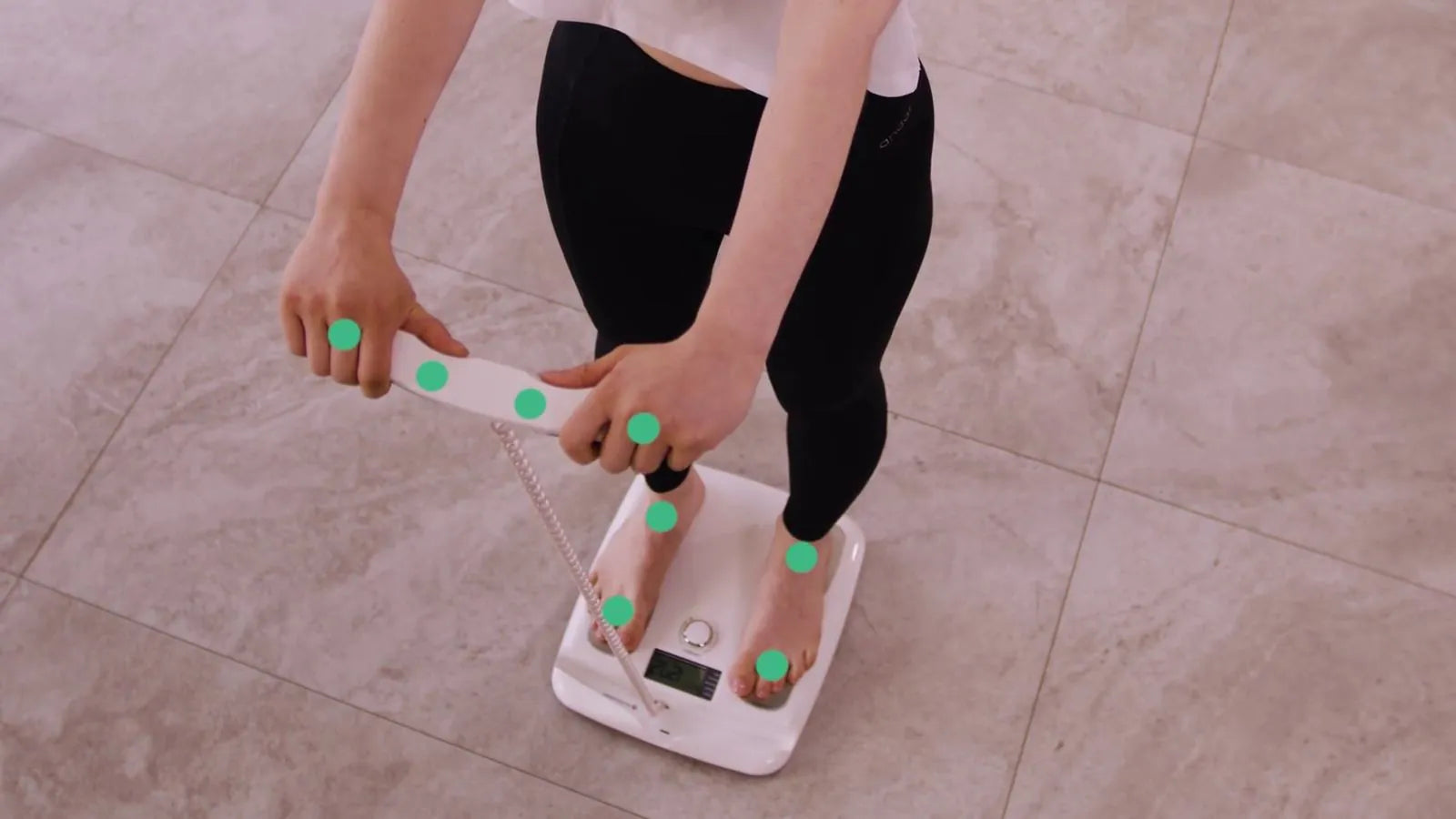
An 8-point scale adds a handle. Every Dial has electrodes under your palms and thumbs as well as under your heels and forefeet, so the current can run between hands, between feet, and from hand to foot. That lets it measure each arm, each leg and the trunk as separate segments. InBody calls this direct segmental measurement.
This is the quiet problem with reading the body as one long conductor. The arms and legs dominate the result. A change around your middle, where many Indians carry fat at a normal weight, can barely register. Measuring the trunk on its own is the way around it.


Why frequency matters
Not all body water sits in the same place. Some is outside your cells, in blood and the fluid between cells. The rest is inside the cells, and much of that is in muscle.
At low frequencies, the current cannot easily cross cell membranes, so it flows around the cells, through the water outside them. At higher frequencies it passes through the membranes as well and reads total water. Comparing the two separates water outside cells from water inside them, which says more about muscle than a single reading can.
Many basic body fat scales use a single frequency, typically 50 kHz. Dial H20 uses two, 20 and 100 kHz, for 10 measurements per test. Dial H30 and H40 use three: 5, 50 and 200 kHz. Across five segments, that adds up to 15 measurements per test on Dial H40.
What a BIA scale can and can’t tell you
From that one test, a Dial reports a set of readings. Every model gives weight, skeletal muscle mass, body fat mass, percent body fat, BMI, basal metabolic rate, the InBody Score and visceral fat level. Dial H30 adds soft lean mass, an estimated waist-hip ratio, body balance and body type. Dial H40 adds leg muscle level, three balance ratings and growth charts for children.
Some scales lean heavily on the age and sex you type in to fill gaps in what they measure. Dial H40 applies no age or sex correction to its result, so two people of the same height and weight get different numbers when their bodies differ.
What BIA can’t do matters just as much. It does not see fat the way a scan does; it infers it. Its estimates rest on equations and on your body water being in a normal state. And it is a fitness and wellness tracking device, not a medical device. It shows what your weight is made of and how that changes. It cannot tell you whether you are unwell; for that, talk to your doctor.
How close a home BIA scale gets to a laboratory method depends on the device. For Dial H20, published studies have compared it with DXA and with a four-compartment model, and found it agreed well and tracked change over months. Those studies cover the H20 only. The full picture is in are body fat scales accurate.
 Dial H40For people who train. Three frequencies, 15 measurements per test, leg muscle level and balance ratings.See Dial H40 →
What changes the reading
Because BIA rides on body water, anything that moves water around your body moves the result for a while. None of these means the scale is wrong. They mean the body it is measuring has changed for a few hours.
- Food and drink. In a study of 18 adults measured 18 times over a day, impedance fell after each meal and stayed lower for 2 to 4 hours, which lowered the calculated body fat.
- Exercise, heat and showers. A workout, a sauna or a hot bath shifts blood and fluid towards the skin and muscles.
- Hydration. A hot day, illness or the days before a period can all change how much water you are carrying.
- Contact and posture. Socks, very dry skin, feet off the plates, or arms pressed to your sides change the path the current takes.
- Height. Height is part of the calculation. On Dial H20 you set it on the dial before each test, so keep it right.
The fix is a routine, not a better day. Same time, same state, same posture. Our guide to getting consistent readings sets it out step by step.
Is a BIA scale safe?
For most people, yes. The current is tiny and you will not feel it. It is the same principle used in clinics and gyms, and InBody devices have run more than 200 million tests worldwide.
There are two standard cautions. InBody advises that people with an implanted electronic medical device, such as a pacemaker, should not use a BIA scale. And InBody advises pregnant women to check with their doctor before using one.
Questions people ask
What is the difference between a BIA scale and a BCA scale?
None in principle. BIA, bioelectrical impedance analysis, is the method. BCA, body composition analyser, is a name for a device that uses it. Look past the label at the electrodes and frequencies.
What is an 8-point BIA scale?
A scale with 8 electrodes: two under each foot and two on each side of a handle you hold. It can measure each arm, each leg and the trunk separately, instead of reading only the path between your feet.
Why does a BIA scale need my height?
Height stands in for the length of the path the current travels. The scale combines it with your impedance and weight to estimate body water. A wrong height gives a wrong result, so keep it up to date.
Can I use a BIA scale if I have a pacemaker?
No. InBody advises that people with an implanted electronic medical device such as a pacemaker should not use it. If you are pregnant, check with your doctor first.
Can children use a BIA scale?
Dial H30 is for ages 3 and up with an adult’s help, and Dial H40 for ages 6 and up. Children need an adult’s help on Dial H20.
Sources
- Kyle UG, Bosaeus I, De Lorenzo AD, et al. Bioelectrical impedance analysis—part I: review of principles and methods. Clinical Nutrition 2004;23(5):1226–1243.
- Foster KR, Lukaski HC. Whole-body impedance—what does it measure? American Journal of Clinical Nutrition 1996;64(3 Suppl):388S–396S.
- Wang Z, Deurenberg P, Wang W, Pietrobelli A, Baumgartner RN, Heymsfield SB. Hydration of fat-free body mass: review and critique of a classic body-composition constant. American Journal of Clinical Nutrition 1999;69(5):833–841.
- Slinde F, Rossander-Hulthén L. Bioelectrical impedance: effect of 3 identical meals on diurnal impedance variation and calculation of body composition. American Journal of Clinical Nutrition 2001;74(4):474–478.
- Misra A, Khurana L. The metabolic syndrome in South Asians: epidemiology, determinants, and prevention. Metabolic Syndrome and Related Disorders 2009;7(6):497–514.
- Siedler MR et al. Assessing the reliability and cross-sectional and longitudinal validity of fifteen bioelectrical impedance analysis devices. British Journal of Nutrition 2023;130:827–840.
- Ellison et al. Assessing body composition for resource-limited settings: agreement of a scalable BIA device compared to DXA and clinical BIA in adults with obesity. Journal of Primary Care & Community Health 2026;17.
- InBody Dial H20, H30 and H40 specifications, InBody India.
 Dial H40
 Dial H30
 Dial H20