Muscle loss after 40: why your parents’ weight can look fine when it isn’t
Muscle slips away from midlife, often while the scale stays put. What age-related muscle loss is, what slows it, and how to watch it at home.

Your father weighs what he weighed ten years ago, and he is quietly proud of it. But he takes the stairs more slowly now, presses on his knees to get up from the sofa, and leaves the gas cylinder for someone else. The scale says nothing has changed. His body says something has.
That gap has a name. Muscle mass and strength tend to drift down from midlife, and when the loss goes far enough, doctors call it sarcopenia. Because fat often fills the space muscle leaves behind, weight can stay flat the whole time. Here is what age-related muscle loss is, why weight hides it, what actually slows it down, and how to keep a calm eye on it at home.
The short version
- After 40, muscle and strength tend to decline slowly, and fat often takes their place. Weight can stay the same while the body underneath changes.
- Walking is good for the heart but is rarely enough for muscle. Strength work two or three times a week and enough protein at every meal matter most.
- A scale that splits weight into muscle and fat shows the drift long before the stairs do. Dial H30 and H40 recognise up to 20 people, so parents simply step on.
What happens to muscle after 40
Muscle is not fixed. Your body builds it and breaks it down all the time, and for most of adult life the two roughly balance. From midlife, the balance tips. Hormones change, daily movement shrinks, appetite falls, and each illness or week in bed takes a little muscle that does not fully come back.
Strength usually goes faster than size. In a large study of older adults followed over several years, leg strength fell noticeably faster than leg muscle mass, which means the muscle that remains also works less well. That is why the first signs are practical ones: a harder time rising from the floor, carrying shopping, or climbing to a second-floor flat.
Many Indian adults start from a lower base. Researchers have long described an Asian Indian pattern of more body fat and less muscle at the same body mass index. Add years of desk work and meals built mostly around rice or roti, and the margin before muscle loss starts to matter can be thin.

Sarcopenia, in plain words
For Asian populations, the reference definitions come from the Asian Working Group for Sarcopenia, known as AWGS, last updated in 2019. They look at three things together, because muscle size alone does not tell you how well someone moves.
AWGS also describes “possible sarcopenia”: weak grip or slow chair stands on their own, even before muscle mass is measured. The idea is to act early, in a clinic or community setting, rather than wait for a fall. A simple first screen it mentions is calf circumference, measured at the widest part: under 34 cm for men or 33 cm for women is a prompt to look further.
These are clinical assessments, and only a doctor can say whether someone has sarcopenia. A home scale cannot make that call. What it can do is show whether muscle is holding or sliding month to month, which tells you when to ask the question.
Why weight alone hides it
Muscle is dense and fat is not, but on a weighing scale a kilo is a kilo. If your mother loses four kilos of muscle over twenty years and gains five of fat, her weight barely moves. Her BMI barely moves. Her doctor may even say she has kept her weight well.
When low muscle and high body fat show up together, researchers call it sarcopenic obesity. It is easy to miss in someone who looks “normal”, and it is exactly the pattern a plain weighing scale cannot see. If this sounds familiar for a younger family member too, the same idea is behind normal weight with high body fat.
What actually slows it down
Strength work, two or three times a week
The World Health Organization advises adults to do muscle-strengthening activity on at least two days a week. For people over 65 it adds varied activity that trains balance and strength on three or more days. Muscle responds to load at any age: in a well-known study, frail adults in their nineties gained strength within eight weeks of supervised training.
At home, that can be simple. Stand up from a chair and sit back down without using the hands, ten times. Push against a wall. Use a resistance band. Step up onto the bottom stair while holding the rail. Start gently, ideally after a word with their doctor or a physiotherapist, and add a little each week.
Walking is good, but not enough
A daily walk helps the heart, blood sugar, mood and sleep. Keep it. But for most people walking does not load the muscles hard enough to build them, so it slows muscle loss less than people expect. Think of it as the base, with strength work added on top.
Protein at every meal
ICMR-NIN sets the protein requirement for Indian adults at about 0.83 g per kilogram of body weight a day. For older adults, the international PROT-AGE group suggests 1.0 to 1.2 g per kilogram, which for a 60 kg parent works out to roughly 60 to 72 g a day. Spread it across meals: curd, paneer, dal, chana, rajma, soy, milk, eggs or fish. Anyone with kidney disease should agree a target with their doctor first.
Keeping an eye on parents at home
Most parents will not book a scan to check their muscle. A scale they already use every morning is a different story. The useful version is one that measures muscle and fat, works for several people, and does not need them to fiddle with an app.
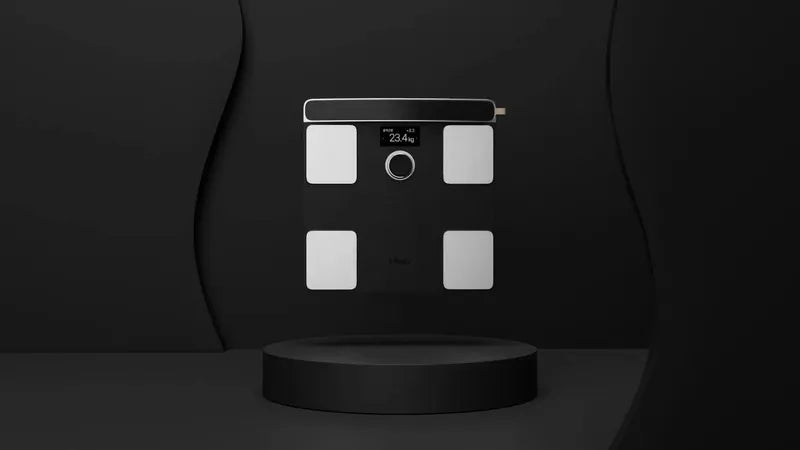
Dial H30 recognises up to 20 people. You set each person up once in the InBody app and start their first test from the phone. After that, they step on, the scale works out who it is, and their nickname shows on the screen for a few seconds in case it picked the wrong person. Results travel over home Wi-Fi, so nobody needs a phone at the scale. If the Wi-Fi drops, the scale keeps up to 15 results per person and sends them when it is back. The full walkthrough is in our InBody app setup guide.


Dial H40 does the same for up to 20 people and adds a leg muscle level and three balance ratings. For parents whose main worry is the stairs and getting up from the floor, leg muscle is a useful number to follow.
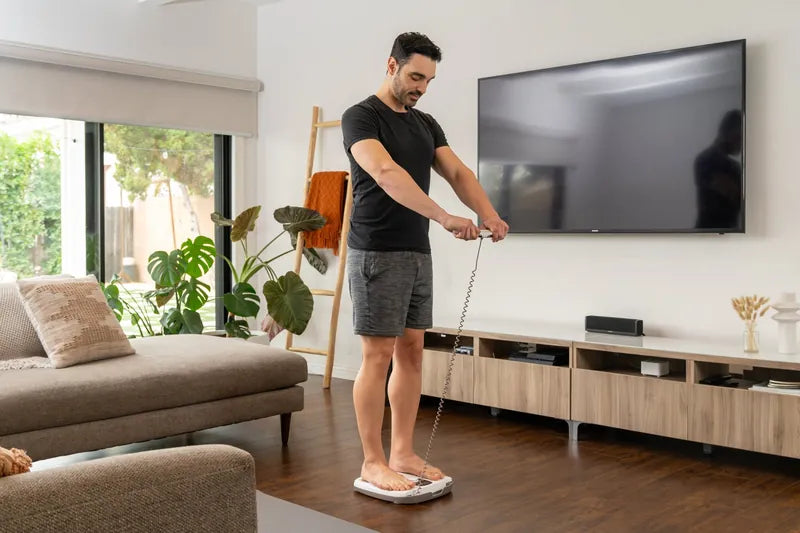
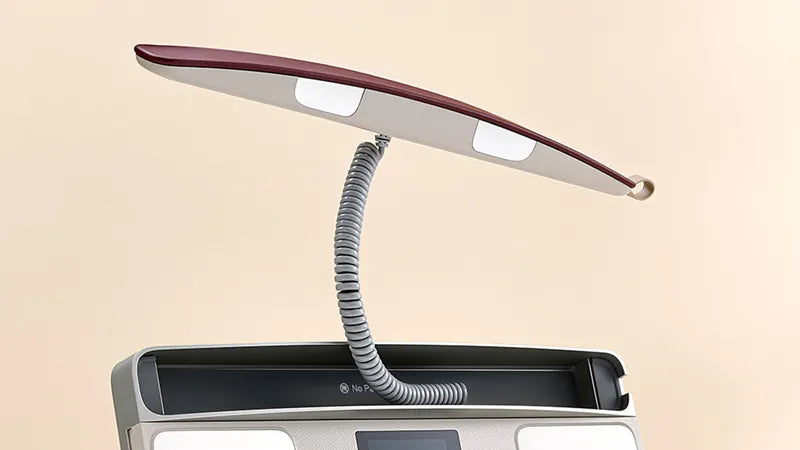
A few practical points. The test takes about 20 seconds, standing still with the handle held out and arms straight, so stay close the first few times if balance is shaky. InBody advises that anyone with a pacemaker or other implanted electronic medical device should not use a Dial. Metal joint replacements do not rule it out, but they can make results less accurate, so follow the trend rather than any single reading.
 Dial H30For the whole house. Recognises up to 20 people and syncs over Wi-Fi, so parents just step on.See Dial H30 →
What to watch, month by month
Day-to-day readings wobble with food, water and sleep. Look at the line over two or three months instead, measured the same way each time: morning, after the toilet, before breakfast. These are the readings worth following, and there is more on each in how to measure muscle mass at home.
- Skeletal muscle mass. Flat or rising is good. A slow slide over months is the signal to add strength work and protein.
- Body fat mass. Rising while weight stays flat usually means muscle is being swapped for fat.
- Leg muscle level and balance, on H40. Useful context for stairs, floors and falls.
- Real life. Can they rise from a chair without their hands? Carry a full bag of vegetables? Those matter as much as any number.
If muscle falls quickly, or weight drops without any effort to lose it, do not wait for the next reading. Book a visit, take the trend along, and talk to their doctor.
Questions people ask
At what age does muscle loss start?
Muscle mass and strength tend to peak in early adulthood and drift down slowly from midlife, often speeding up after 60 or so. The pace varies a lot from person to person, and strength training and protein can slow it at any age.
Can sarcopenia be reversed?
Muscle responds to training well into old age, and studies have shown strength gains even in people in their nineties. Whether someone’s muscle loss counts as sarcopenia, and what to do about it, is a question for their doctor or physiotherapist.
Is walking enough to prevent muscle loss?
Walking is excellent for the heart and blood sugar but usually does not load muscles enough to build them. The World Health Organization advises muscle-strengthening activity on at least two days a week, and balance and strength work on three or more days for people over 65.
Can a body composition scale tell if my parent has sarcopenia?
No. Sarcopenia is assessed by a clinician using muscle mass, grip strength and physical performance tests. A Dial is a fitness and wellness tracking device: it shows skeletal muscle mass and body fat over time, which helps you notice a trend worth raising with a doctor.
Can my parents use a Dial without a smartphone?
Yes, once it is set up. Someone with the InBody app adds each person and starts their first test from the app. After that, Dial H30 and H40 recognise them when they step on and send results over home Wi-Fi, with no phone needed at the scale.
How much protein does an older adult need?
ICMR-NIN puts the adult requirement at about 0.83 g per kilogram a day, and the PROT-AGE group suggests 1.0 to 1.2 g per kilogram for older adults. People with kidney disease should agree their target with a doctor.
Sources
- Chen LK et al. Asian Working Group for Sarcopenia: 2019 consensus update on sarcopenia diagnosis and treatment. Journal of the American Medical Directors Association 2020;21(3):300–307.
- Goodpaster BH et al. The loss of skeletal muscle strength, mass, and quality in older adults: the Health, Aging and Body Composition Study. Journals of Gerontology Series A 2006;61(10):1059–1064.
- Fiatarone MA et al. High-intensity strength training in nonagenarians: effects on skeletal muscle. JAMA 1990;263(22):3029–3034.
- World Health Organization. WHO guidelines on physical activity and sedentary behaviour, 2020.
- Bauer J et al. Evidence-based recommendations for optimal dietary protein intake in older people: a position paper from the PROT-AGE Study Group. Journal of the American Medical Directors Association 2013;14(8):542–559.
- ICMR-National Institute of Nutrition. Nutrient Requirements for Indians, 2020.
- Misra A, Khurana L. The metabolic syndrome in South Asians: epidemiology, determinants, and prevention. Metabolic Syndrome and Related Disorders 2009;7(6):497–514.
- InBody Dial H20, H30 and H40 specifications, InBody India.
 Dial H40
 Dial H30
 Dial H20