Lean body mass, soft lean mass and skeletal muscle mass, explained
Three lean numbers, three different things. What lean body mass, soft lean mass and skeletal muscle mass each include, and which one to track for your goal.
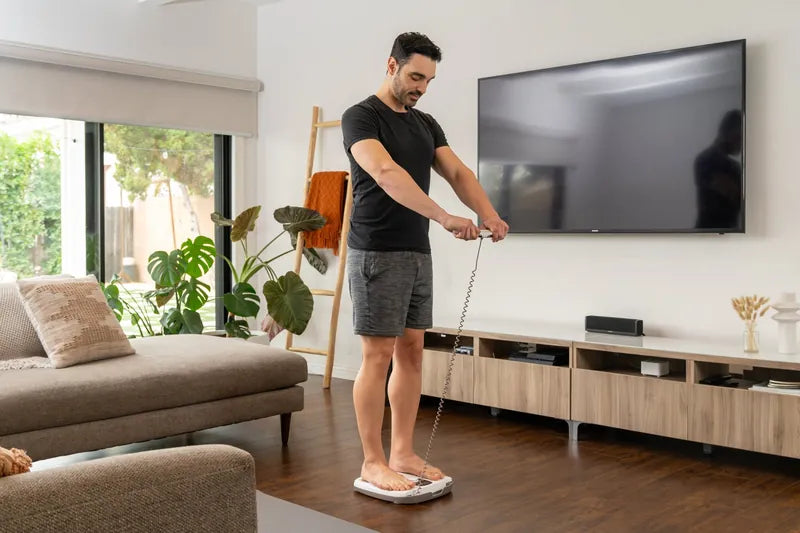
Lean body mass is everything in you that is not fat: muscle, organs, bone, skin and the water inside all of them. Soft lean mass is the same thing minus bone mineral. Skeletal muscle mass is only the muscle attached to your bones, the muscle you train. Each is a smaller slice of the one before.
The three are easy to mix up, and apps and gym printouts often use them loosely. The difference matters, because the right number depends on what you are trying to do. Losing weight, getting stronger and keeping an eye on an ageing parent each call for a slightly different one. Here is what each includes, and which to watch.
The short version
- Lean body mass, or fat-free mass, is your weight minus your fat. It includes water, organs and bone, and it moves with your hydration.
- Soft lean mass is lean body mass minus bone mineral. Dial H30 and H40 report it.
- Skeletal muscle mass is the muscle you can build. It is the best single number for strength, for ageing, and for checking that weight loss is coming from fat.
Three lean numbers, one body
Start with your weight and take away your fat. What is left is lean body mass. Strictly, scientists separate fat-free mass, which has no fat at all, from lean body mass, which keeps the small amount of essential fat in your nerves and cell membranes. In everyday use the two names are swapped freely, and the difference is small.
Take away the mineral in your bones, a few kilos in most adults, and you have soft lean mass: muscle, organs, skin, blood and body water. Inside that sits skeletal muscle mass, the muscle that moves your joints. In a study of 468 adults aged 18 to 88, skeletal muscle made up roughly a third of body weight on average, more in men and less in women.
That last point catches people out. Many smart scales show a “muscle mass” that is really closer to soft lean mass or lean body mass. Switch to a scale that reports skeletal muscle and it can look as if you lost ten kilos of muscle overnight. You did not; you changed what was being counted. Our guide to measuring muscle mass at home covers that switch.
Lean mass is mostly water
Here is the fact that explains most of the day-to-day wobble. In adults, water makes up about 73 percent of fat-free mass. Researchers reviewing decades of data describe that ratio as one of the steadiest constants in body composition, and it is part of why impedance scales work at all.
So when you dehydrate on a hot day, eat a salty dinner or start a low-carbohydrate diet, the lean side of your result is what moves. Your body stores carbohydrate as glycogen along with water, and emptying those stores in the first week of a diet can take a kilo or more off the scale with very little to do with fat or muscle.
This is why a drop in lean body mass in week one is rarely lost muscle, and why skeletal muscle mass, judged over a month, is the more trustworthy figure. It is also why the testing routine matters so much: same time, same state, every time. The details are in our guide to consistent readings.
Which number to track for your goal
| Your goal | Watch | Why |
|---|---|---|
| Losing weight | Body fat mass and skeletal muscle mass | Fat should fall while muscle holds |
| Getting stronger | Skeletal muscle mass; leg muscle level on Dial H40 | It is the part training changes |
| Parents over 60 | Skeletal muscle mass | Muscle tends to decline with age |
| Weight-loss medication | Skeletal muscle mass and body fat mass | Rapid loss can include muscle |
| Working out calories | Lean body mass | Lean-mass formulas for BMR use it |
Losing weight
Your weight alone cannot tell you what you lost. Watch body fat mass and skeletal muscle mass side by side. If fat falls and muscle holds, the plan is working even when the scale is slow. If both fall steadily, add protein and strength training. On weight-loss medication, talk to your doctor before changing anything, and read our guide to weight-loss injections and muscle.
Getting stronger, or staying strong
Skeletal muscle mass is the number that strength training moves, slowly. Dial H40 adds a leg muscle level and three balance ratings, which help people who train notice if one side or the lower body is lagging. For parents, the same number is the one to watch. Muscle tends to decline from middle age, often without any change in weight. More in muscle loss after 40.
Working out how much you burn
Lean body mass earns its place here. Some formulas for basal metabolic rate, such as Katch–McArdle, start from lean mass rather than from weight, because lean tissue drives most of your resting burn. Our guide to BMR and muscle explains the difference.
Soft lean mass, and where to find each number
Every Dial reports skeletal muscle mass and body fat mass at every test. Dial H30 and H40 also report soft lean mass, with your result shown against a standard range in the InBody app. It gives you a broad sense of how much lean tissue you carry for your size. For tracking training, skeletal muscle is the sharper tool, because it isolates the part you can build.
Dial H20 does not list lean body mass or soft lean mass among its eight readings, but you can work out lean body mass on any Dial in a second: your weight minus your body fat mass. A 62 kg reading with 20 kg of body fat means 42 kg of lean body mass.


 Dial H40For people who train. Skeletal muscle mass, soft lean mass, leg muscle level and balance ratings, 14 readings in all.See Dial H40 →
How to track lean numbers without fooling yourself
Muscle is built slowly. A good month of training adds an amount that would be invisible on any single morning, while water moves your lean numbers by more than that from one day to the next. So the rules are simple.
- Test the same way. Morning, after the toilet, before food, drink or exercise, bare feet, arms straight with the handle.
- Judge monthly. Compare four-week blocks of skeletal muscle readings, not Tuesday with Friday.
- Stick to one device. A gym analyser, a clinic test and a home scale use different equations. Compare each only with itself.
- Train, then wait. Test the next morning, never straight after a session.

If you want one number to anchor everything else, make it skeletal muscle mass, read alongside body fat mass. Lean body mass and soft lean mass are useful context. Skeletal muscle is the one that tells you whether your effort is turning into muscle.
Questions people ask
Is lean body mass the same as muscle mass?
No. Lean body mass is everything that is not fat, including water, organs and bone. Skeletal muscle mass is only the muscle attached to your bones, so it is much smaller, often around half of lean body mass.
Is lean body mass the same as fat-free mass?
Almost. Fat-free mass has no fat at all; lean body mass keeps the small amount of essential fat in nerves and cell membranes. Most apps and articles use the two terms interchangeably.
What is soft lean mass on InBody?
Lean body mass minus bone mineral: muscle, organs, skin, blood and body water. Dial H30 and H40 report it and show it against a standard range in the app.
Why did my lean mass drop in the first week of my diet?
Most likely water. Early weight loss often includes glycogen and the water stored with it, and lean mass is mostly water. Judge skeletal muscle mass over a month, and keep protein and strength training in your plan.
What is a good skeletal muscle mass for my weight?
It depends on your height, weight and sex, so there is no single good number. The app shows your reading against a standard range for your body. Your own trend matters more than comparisons.
Sources
- Janssen I, Heymsfield SB, Wang ZM, Ross R. Skeletal muscle mass and distribution in 468 men and women aged 18–88 yr. Journal of Applied Physiology 2000;89(1):81–88.
- Wang Z, Deurenberg P, Wang W, Pietrobelli A, Baumgartner RN, Heymsfield SB. Hydration of fat-free body mass: review and critique of a classic body-composition constant. American Journal of Clinical Nutrition 1999;69(5):833–841.
- Kreitzman SN, Coxon AY, Szaz KF. Glycogen storage: illusions of easy weight loss, excessive weight regain, and distortions in estimates of body composition. American Journal of Clinical Nutrition 1992;56(1 Suppl):292S–293S.
- Chen LK et al. Asian Working Group for Sarcopenia: 2019 consensus update on sarcopenia diagnosis and treatment. Journal of the American Medical Directors Association 2020;21(3):300–307.
- InBody Dial H20, H30 and H40 specifications and InBody app, InBody India.
 Dial H40
 Dial H30
 Dial H20